
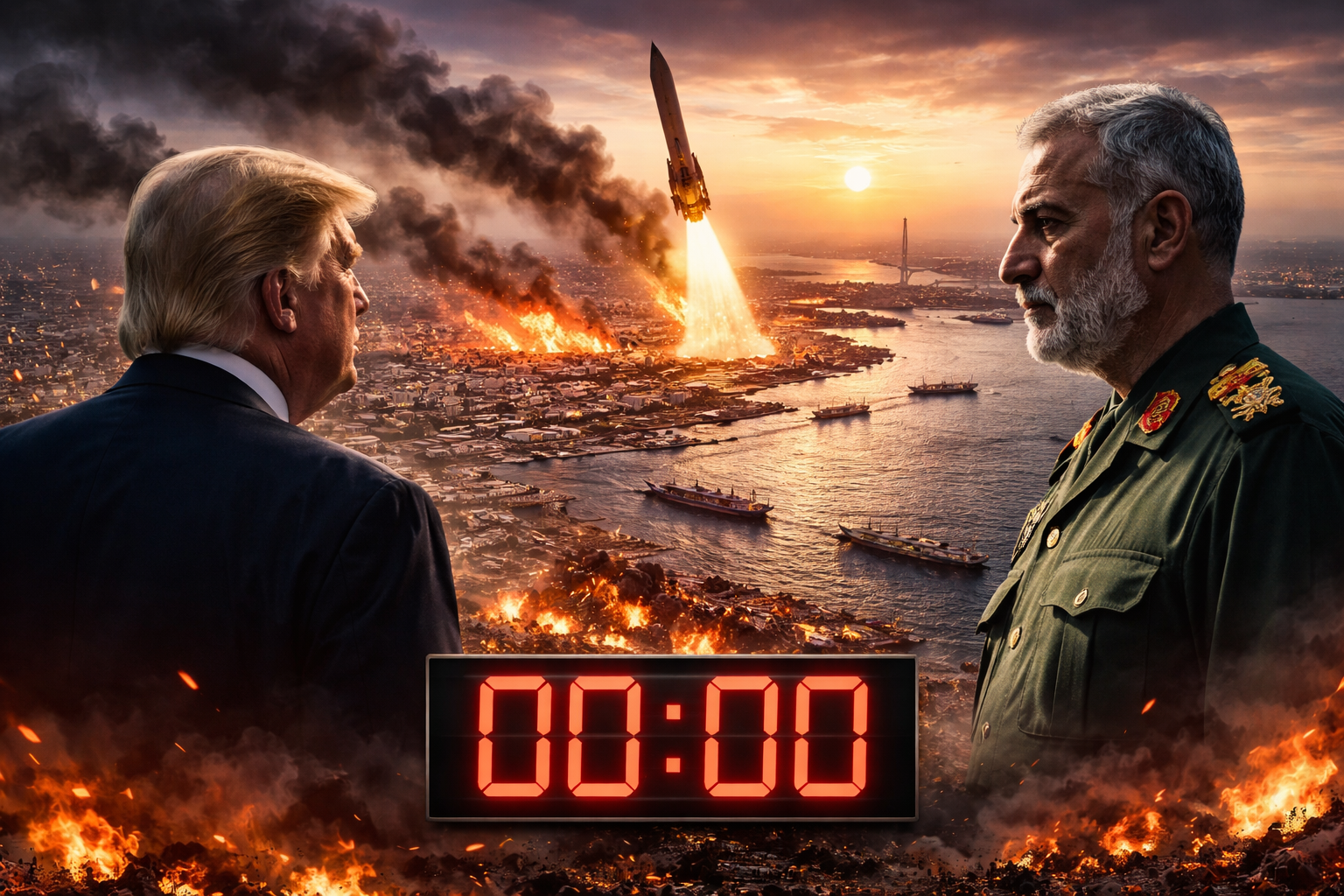
Fifty days into a war that has rewritten the rules of global energy, the Strait of Hormuz has opened and closed three times already.

The last opening lasted less than 24 hours. The ceasefire expires on Wednesday.
And the people who actually move oil around the world are far more alarmed than the people trading it.
How a waterway became a weapon
As the war began on February 28, Iran quickly found out that its biggest weapon was not a drone or a missile, but a waterway.
Iran closed the Strait of Hormuz to all foreign shipping, triggering what has since been described as the largest oil supply disruption in recorded history.
Tanker traffic, which initially dropped around 70%, fell to virtually zero within days. Roughly 2,000 ships and 20,000 sailors became stranded around the chokepoint, carrying nearly 21 billion litres of oil.
The IRGC transmitted warnings via radio to every vessel in the area: no ship is allowed to pass.
The US launched an aerial campaign to reopen the strait on March 19. It moved the needle very little.
By late March, Trump was threatening to destroy Iran’s infrastructure entirely if it did not reopen the waterway.
In early April, a partial ceasefire was reached, but Iran used the pause not to reopen the strait fully, instead charging tolls of over one million dollars per ship.
The opening that lasted one afternoon
On April 7, Trump agreed to a two-week ceasefire in exchange for Iran fully reopening the strait. Iran’s foreign minister confirmed it on April 17, declaring the waterway “completely open.”
Markets went into immediate euphoria.
Oil dropped 10 to 12%. Stocks surged. Trump posted a celebratory “Thank you!” on Truth Social.
And by Saturday morning, Iranian gunboats were firing on tankers attempting to cross.
But what matters is what happened in between.
On Friday evening, Trump confirmed publicly that the US naval blockade of Iranian ports would remain in place regardless of any ceasefire. From Tehran’s perspective, that statement made the reopening meaningless.
Iran had offered the strait as a gesture tied to the parallel Israel-Lebanon ceasefire, not as an unconditional concession. When the US signalled it was taking the gesture without giving anything in return, Iran reversed course within hours.
The strait closed again. The ceasefire now expires in three days. There is no confirmed second round of talks. Iran has not agreed to return to the table.
The deadlock behind the deadlock
The strait is the leverage tool. The nuclear program is the actual war, and it is where the talks keep breaking down.
In Islamabad, 21 hours of direct negotiations between a 300-member US delegation led by JD Vance, Witkoff and Kushner and a 70-member Iranian team produced nothing.
Talks collapsed because Iran refused the US red lines of a complete end to uranium enrichment, dismantling of all major enrichment facilities, and transfer of its stockpile of highly enriched uranium to the US.
Iran currently holds around 400 kilograms of 60%-enriched uranium, dangerously close to weapons-grade. Trump claimed Iran had agreed to hand it over.
The problem here is not a matter of negotiating style. It is that these two positions cannot be split in half.
Iran watched the 2015 nuclear deal get torn up by Trump himself in 2018, so even if Tehran signed something on enrichment, the credibility that the US would honour it through a future administration is close to zero. That history is embedded in every Iranian calculation at the table.
What makes the situation more unpredictable is what is happening inside Iran.
With the IRGC now the dominant power following Khamenei’s death, hardline voices calling for Iran to withdraw from the Nuclear Non-Proliferation Treaty and pursue an outright nuclear weapon have grown louder and more public than at any point in the Islamic Republic’s history.
Iran’s foreign ministry is sending diplomatic signals abroad while hardliners at home demand the opposite.
This is a government genuinely torn between economic survival and ideological identity, and the mixed signals on the Strait are the external symptom of that internal war.
Trump has noted publicly that he sees a “divide” within the Iranian government. He is right, although that divide makes a deal harder to close, not easier.
What the market is getting dangerously wrong
After Russia invaded Ukraine in 2022, oil futures hit $130 a barrel when roughly two to three million barrels per day were at risk.
The Strait of Hormuz carries approximately 20 million barrels daily. Futures this week dropped below $90 on a diplomatic announcement that lasted less than one afternoon.
The market is not pricing the conflict. It is pricingTrump’s social media feed, and trading algorithms are doing the rest. Even in the best-case scenario, normalisation takes months.
Mine needs clearing. Insurance premiums will not fall until shipping companies believe passage is genuinely safe. Gulf state production infrastructure has suffered damage that cannot be tallied until bombing stops for good.
The COVID comparison is uncomfortable but accurate.
Markets bounced in spring 2020 while supply chains fractured quietly, and the hangover arrived 12 to 18 months later as inflation, the Fed was forced to fight with the sharpest rate-hiking cycle in four decades.
Q2 earnings season in July is where this energy disruption finally shows up on the income statement.
The most durable positions belong to US shale producers with zero Hormuz exposure and American LNG exporters locking in long-term European contracts.
What does not survive a failed Wednesday is the assumption, baked into record equity valuations, that this resolves quickly. The people who actually move oil around the world have been saying so for weeks.
The post The Strait of Hormuz keeps markets on edge as ceasefire deadline nears appeared first on Invezz